The Moscow summit ended today. Africa’s leaders toured a showroom, were handed ice-cream and heard promises. It is time the continent set the terms instead.
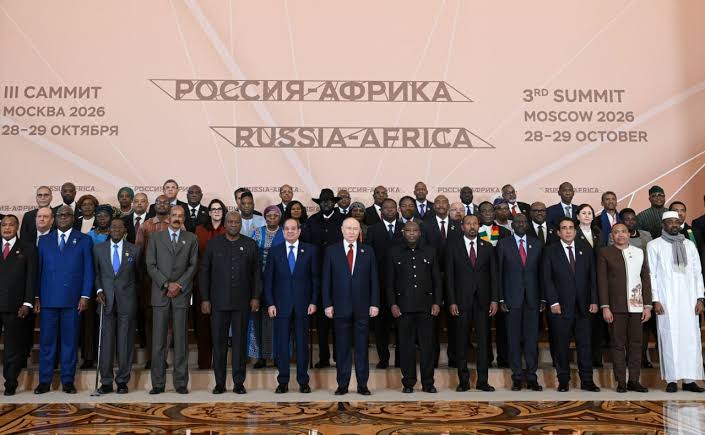
The third Russia–Africa Summit closed in Moscow today, 29 October, after two days ofspeeches, signings and photographs. Delegations from 48 African countries attended, 22 of them led by heads of state or government. It was the third summit in a row held on Russian soil, despite repeated promises to hold one in Africa.
The trip was a familiar one. In December 2022, leaders from 49 African countries flew to Washington, which pledged $55 billion over three years. In September 2024, 51 heads of state went to Beijing, where China pledged about $50.7 billion.
In between came Riyadh, Rome, Seoul and Yokohama. Türkiye’s fourth Africa summit is due this year. Each follows the same script: one host, one agenda, some 50 African delegations, and a pledge read from the podium.
A few summits do meet in Africa — the AU–EU summit in Luanda last November is one.
They are the exception. Africa has 1.5 billion people and 54 sovereign states, yet it is almost always the guest and rarely the host.
This is not partnership. It is a continent being auctioned one capital at a time.
Ice cream for presidents
The picture that will outlast this summit is not a signing ceremony. On the first day, after the plenary session, President Putin walked the heads of African delegations through an exhibition of Russian technology: hospitals, tax systems, a new fishing fleet. Then he treated them to Russian ice cream, and took a cup himself.
Hospitality is not a crime. But look at the scene from Lusaka, Lagos or Harare. Presidents and prime ministers of sovereign nations, answerable to hundreds of millions of citizens, were led around a showroom and handed a sweet at the end, like pupils on a school outing. The host played headmaster. Our leaders played the class.
The Summit Circus
Protocol is power. Who sets the agenda, who speaks first, who hands out the treats and
who receives them: every detail tells the world who is in charge. No one expects to see the presidents of Russia, China or the United States walked through an African exhibition and handed ice cream at the exit.
That such a picture of African heads of state could be taken at all, and shared as a charming moment, shows how far the continent still has to go. The problem is not the ice cream. It is that the picture looked normal.
The smaller party set the terms, The numbers make the scene stranger still. Russia has about 143 million people. Africa has about 1.5 billion: more than ten times as many, and more than Russia, the United States and the European Union put together.
Russia’s economy, at about $2.5 trillion, is smaller than Africa’s combined $3.1 trillion. Its trade with Africa reached about $27 billion last year, well short of the $40 billion target Putin set in 2019. China’s trade with Africa was about $348 billion, and the EU’s about $395 billion.
Yet it was the smaller party that sent the invitations, chose the city, wrote the programme and handed out the ice cream. Size has never been Africa’s problem. Organisation has.
The richest ground,the smallest share.
Africa holds about 30% of the world’s mineral reserves, according to the UN Environment Programme. That includes some 40% of the world’s gold, up to 90% of its chromium and platinum, and the largest reserves of cobalt, diamonds and uranium.
The Africa Finance Corporation values these minerals at $29.5 trillion at the mine site —about a fifth of the world’s total. Some $8.6 trillion of it is still undeveloped: more thantwice Africa’s entire annual output.
Yet Africa’s whole economy came to about $3.1 trillion in 2025. That is roughly 2.6% of
world GDP, and smaller than France’s alone.
Economy Share of world population
Africa (54 countries): 19% – 3.1, 2.6%
United States and Canada: 5% – 32.9, 28%
China: 17% – 19.4, 17%
France: 1% – 3.4, 3%
Russia: 2% – 2.5, 2%
The gap is value addition. Africa’s iron ore is worth about $2.8 trillion in the ground; the AFC estimates it would be worth some $25 trillion as steel. We ship the ore and buy back the steel.
Colonisation by contract
At the Berlin Conference of 1884–85, European powers divided Africa among themselves without a single African at the table. In the 21st century, Africans are invited, fed and photographed, and the dividing goes on through contracts.
Today’s colonisation needs no flags and no governors. It works through privatisation: exploration rights, mining licences, concessions and offtake deals handed to companies that answer, in the end, to foreign governments.
Moscow showed the model at work. Rosgeologiya, Russia’s state-owned geological company, agreed to map prospective ground across more than half of Mali and to help run the system that manages its geological data and mining licences. Of the 21 agreements Russia reportedly signed with 14 African countries, 15 were about geology.
Whoever maps the ground learns its value first. Whoever runs the licence registry knows who owns what.
Russia is not alone. A US congressional committee estimates that Chinese companies control nearly 90% of Zimbabwe’s lithium reserves. Across the continent, a large share of the cobalt, copper, bauxite and uranium that leaves African soil is mined, financed or bought by foreign companies, many of them owned or backed by their governments.
The minerals remain African on the map. The ownership, the processing and the profits increasingly do not. That is colonisation in a business suit.
Why our leaders keep boarding the plane
Four forces keep the planes full.
1. Debt. The UN Economic Commission for Africa counts 23 African countries in or at high risk of debt distress — more than 40% of the continent. For them, a summit pledge is budget relief, not strategy.
2. Bargaining alone. Zambia negotiates its copper alone. The DRC negotiates its cobalt alone. Each faces a buyer with one national strategy, so divide-and-rule needs no plot; it is simply the default.
3. No refineries of our own. China refines about 65% of the world’s lithium, 76% of itscobalt and around 90% of its rare earths, according to the IEA. A country with no processing cannot refuse to sell raw ore, because it has nowhere else to send it.
4. The photograph. A handshake in the White House, the Great Hall of the People or the Kremlin is valuable currency in domestic politics, even when it ends with a cup of ice cream.
The growth story they don’t tell
Africa is not the world’s patient. IMF projections suggest 2026 will be the first year in modern history that Africa’s economies grow faster than Asia’s.
The IMF’s April 2026 outlook puts Ethiopia at 9.2% growth, Guinea at 8.7% and Uganda at 7.5% — among the fastest rates on earth. It also expects Africa to lead every region ingrowth through 2029, at about 4.4% a year.
We are a growth engine that still negotiates like a supplicant.
The Zambezi Doctrine: five shifts
Self-respect is not a feeling. It is a strategy. The Zambezi Institute proposes five shifts.
1. Host, don’t travel. The AU should resolve that, from 2028, African leaders stopattending “Country X–Africa” summits abroad. In their place: one annual Africa–World Summit, alternating between Addis Ababa and Accra, run by the AU and the AfCFTA Secretariat. One agenda, set by Africa.
2. Negotiate as one. The AfCFTA joins some 1.4 billion people — a market as populous asIndia. Africa should create an African Critical Minerals Exchange to set floor prices for cobalt, lithium, platinum and rare earths. No state should sell strategic minerals outside that common framework.
3. End raw mineral exports by 2030. The direction is already set. Zimbabwe banned raw lithium ore exports in 2022, and in February 2026 halted exports of all raw minerals and lithium concentrate. Ghana’s President Mahama has pledged that from 2030 no mineral ore will leave Ghana unprocessed, and Namibia and Malawi have moved the same way.
Earlier this month, Accra’s Mining in Motion summit met under the theme “One Continent.
One Voice on Minerals.” That slogan should become continental law. If the world wantsAfrica’s lithium, the battery plants belong in Kolwezi, Bulawayo and Francistown.
4. Own the digital layer. AI is the next resource race. If Africa exports the minerals inside AI chips, then imports AI models that do not speak Shona, Swahili, Amharic or Yoruba, it becomes a digital colony. Africa needs its own cloud, its own data centres and AI built for African languages.
5. Finance our own future. African pension funds manage more than $600 billion, mostly in government bonds; less than 1% reaches private equity or venture capital. Washington, meanwhile, has put a record $10 billion EXIM loan behind Project Vault, a US stockpile of the very minerals Africa digs up.
African governments should require a fixed share of pension and sovereign wealth assets — we propose 20% — to go into African industry and processing. The AfDB should build the pipeline of bankable projects to absorb it.
Make the world come to Africa
Respect is not requested in Washington, Beijing or Moscow. It is manufactured, refined,coded and financed at home.
Until Africa stays home and makes the world come to it, we will keep sending ourpresidents to hear terms from a single host. This week, 48 African delegations travelled to a country with a tenth of Africa’s people and a smaller economy. They came away with promises, paperwork and a cup of ice cream.
Africa does not need more invitations to summits. The world needs an invitation to Africa.
The Zambezi Institute · Research | Policy | African Dignity · Harare — Lusaka — Accra
Disclaimer: This article is an opinion piece which does not reflect the views of the Zambezi Institute.